Tuesday, October 25, 2011

Let the maintenance begin!

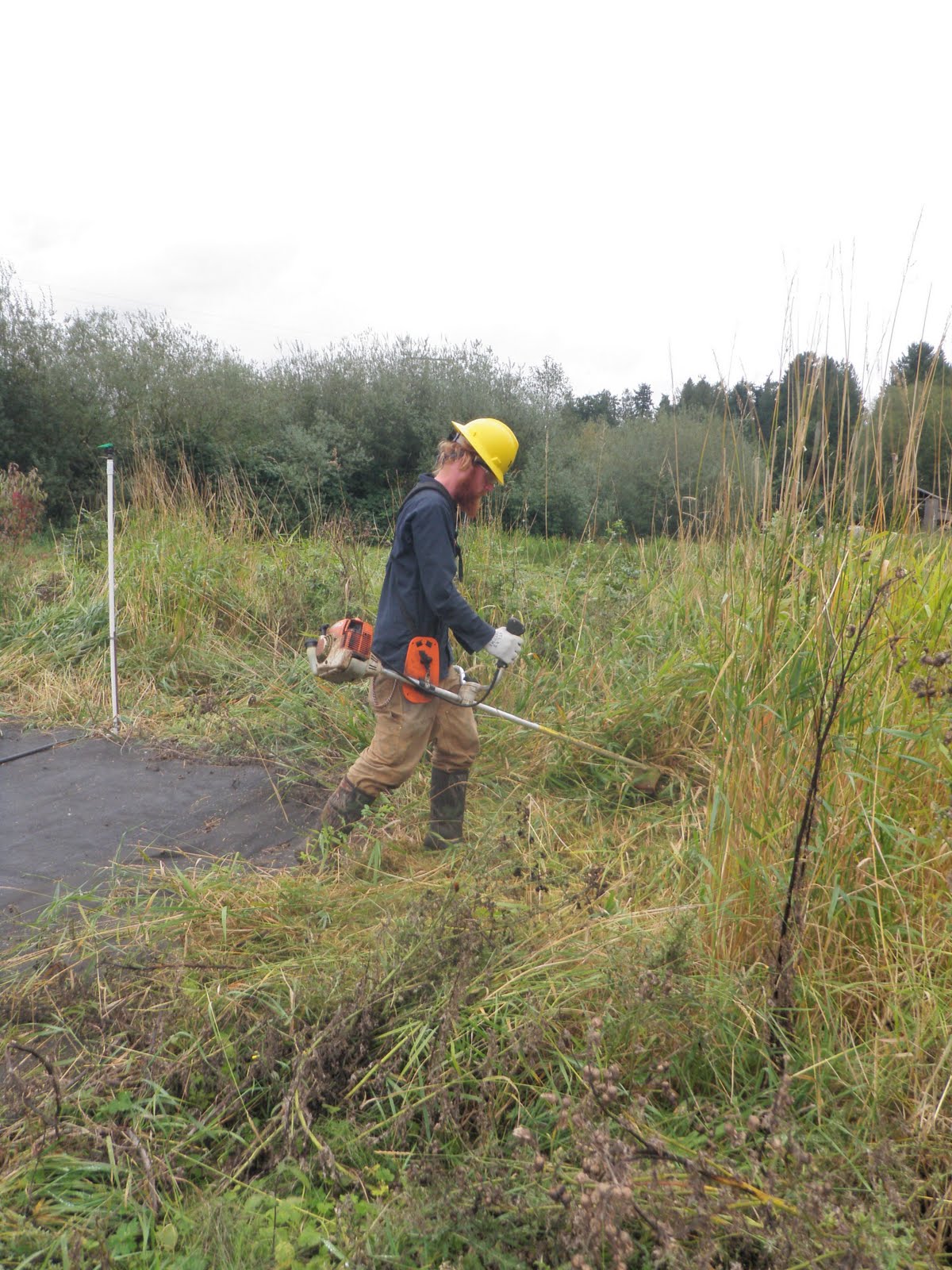
The crew has been hard at work maintaining Conservation Reserve Enhancement Program (CREP) sites in the area. Overrun with non-native, invasive plants such as Himalayan Blackberry and Reed Canary Grass, the crew put their brush cutters to good use to save the native plantings from being taken over by invasives.


For more information on the Conservation Reserve Enhancement Program visit http://www.fsa.usda.gov/FSA/webapp?area=home&subject=copr&topic=cep .

Thursday, October 6, 2011

Introducing the crew!

I am proud to introduce the new 2011/2012 crew. They claim to be bigger, faster, and stronger than crews in the past... We'll soon find out.

Crew Members:

Sam Erman
Hey everyone! My name is Sam Erman and am a recent graduate from the Environmental Studies program at the University of Oregon. I have joined the Washington Conservation Corps to further my environmental education, while gaining hands on experience in the field of environmental conservation. I’m extremely excited to spend a year in Port Hadlock with the Washington Conservation Corps and do some serious riparian restoration!


Elijah Roulst
My name is Elijah Roulst,
Born and raised in the Chimacum area. Grew up around the outdoors. I enjoy hiking, fishing, traveling, and going to shows. As a Sophomore at Chimacum High School I was part of the 2007 State Championship 1A Baseball team, and 3rd Place as a senior.  In my down time you will find me listening to music 24/7, spending time with family and friends, and being in the outdoors as much as possible. I am currently in the process of studying Environmental Studies, and I plan on getting in to Music Production as well. I am very happy to be working with the WCC, and excited to be with a good crew for the next year.  


Jayde Rector
My name is Jayde. I grew up in the Olympic Peninsula, one of the best places on earth. I rather enjoy gardening, hiking, and basically most things that involve being outdoors. I am stoked to get to help out nature’s garden with WCC this year. After this adventure I hope to work on organic farms in various places and then come back and go to school in Edmonds. 


Carrie Clendaniel
Hello! My name is Carrie Clendaniel. I grew up on Discovery Bay, but have spent the past 7 years living in the Midwest and East Coast. I did my undergrad in Chicago, and received a Master’s degree in Biology from a research institute in New York. Now I am following a life-long passion for the outdoors and environmental conservation—I am so excited to be back in the Northwest and ready to learn restoration techniques! I am going to use this year as an introduction to a new field. I will gain lots of experience, learning through job opportunities and through volunteer work, and hope to better define what environmental path I want to take in the future. This community, with its local natural resources and strong community resource management (plus being the spot I’ve always considered home!) is the perfect place to start! Hope to meet some of you in the field, ~ Carrie


 Warren Young
GREETINGS,
WARREN HERE.
I am entering as a second year corps member, at the age of twenty-three. Before this I was working for the WCC Skagit Spike crew within the counties of Whatcom, Skagit and Islands- Cascadia Crew; for a six-month term (from April 2011). Then before that, I was working for the city of Bellingham crew also for a six-month term (from April 2010). Before the Washington Conservation Corps, I went through three quarters of community college at Whatcom Community College (another WCC), then transferring to Bellingham Technical College and gaining an associates degree in Fisheries Technology within two years. In between working and school, I am a traveling man, I enjoy hitchhiking, meeting new people and seeing places I had never seen before.
I am looking forward to a full year of the Conservation Corps, at the Port Hadlock because of their work with salmon restoration of the riparian zones of the area.
Looking forward in blogging about me and my work for the next year-
:BLOG OUT

Thursday, September 22, 2011

Goodbye folks!

It's hard to believe that this is our last week as a crew here in Port Hadlock.  Come October NOSC will be welcoming a brand new crew to the area.  We rounded out our year with knotweed surveying and treatment on the Quilcene and Dosewallips rivers, further butterfly bush removal on the Dungeness, and a tree cage project with DNR.

Chris building a cage to protect plants from deer

A portion of the project caged
Dosewallips knotweed surveying
Butterfly bush
Elwha dam removal field trip
Today is our last day...hopefully all limbs will remain intact and much butterfly bush will be destroyed.  Best of luck to next year's crew!

Monday, August 29, 2011

Taking on the ultimate invasive...

That's right, it's early fall and time to take on Japanese Knotweed.  The only thing going for this weed in comparison to other stuff we have to deal with is that it doesn't have thorns.  Otherwise, it's pure evil - a plant that grows back from mere fragments (so you can't cut it down), has dense root systems (can't just pull it out), grows incredibly quickly almost anywhere along a riverbank (can't crowd it out with native plants), and can therefore only be fought with herbicide.  While this particular invasive is nasty, it does lead us to some beautiful locales; we are currently hiking the Big Quilcene River, surveying and spraying the knotweed we find.  This job will take us almost all the way through the end of September, to the end of our service year.

Lou spraying Japanese Knotweed
Chris taking a GPS point
Lou helping James out with his bug-spray needs

Sunday, August 14, 2011

Hello from Port Hadlock WCC! Apologies for the long haitus.  July has been crazy - full of jobs, members on spike, members on summer break...however, we're finally all back together kicking butt.

Our first order of business was to recieve Crew of the Quarter in the WCC Program in recognition of our hard work both on the job and in our volunteer activities.

What can we say.  It was inevitable.
After attaining this lofty title we headed for a job with the WDFW fixing up a restoration site and prepping an old building for excavation.  Jobs included mowing, ivy-pulling, and cutting out invasives and trees in the way of the excavator.  We also did a field trip over to the Gary Oak planting site to help volunteers with weeding.

Before
After
However, the majority of our time has been spent on the beautiful Dungeness River working for the Jamestown S'Klallam tribe. 

The riparian area is infested with butterfly bush, a big tree-like woody shrub that looks like lilac and has a tendency to completely out-compete native plants.  Armed with chainsaws, loppers, and herbicide, we cut the trees/bushes down and sprayed the stumps to prevent them from growing back.  This will allow natives such as cottonwoods and conifers to grow.  These large native trees are key to large woody debris recruitment in rivers and help to create the log jams needed for healthy habitat.

James about to throw down some Butterfly Bush pain...
AJ cutting a particularly large specimen

   
Lou excited to saw
Packing it in after three weeks of work.

Thursday, July 7, 2011

The Crew is off on break . Here's we did the last week of June....

Of course there was some planting site maintenance that needed taken care of, which we took care of. Finn River Farms restoration site on Chimacum Creek needed a little TLC.  We also traveled up to Port Angeles and put tree protectors on the trees and did some tree release.


This is what it looks like for the weeds that get in our way

taking them off
Putting them on

Weeds and tree protecting at Morse


.Next we went to Lee Millers on Chimacum Creek.  Al Latham, with the Jefferson County Conservation District, arranged a small scale log moving project intended to improve salmon habitat.  The crew seemed to really enjoy this project, and Lee Miller was great.  He even brought us drinks and cookies.
Katie carrying the grip hoist to the work site

Lou and Chris running the hoist

Wait where are we moving the log?

James has the rigging all hooked up

Al thought I should move the choker before it was completely buried, he was right.

Notice the log on the opposite bank.  That is what is being winched by Chris and Lou

These guys look tough

Yeah... this didn't work out
James is keeping an eye on the anchor tree

Ok, we got 2 in the channel, should be interesting in the winter high flows. 

James posing with our work


Monday, June 27, 2011

WCC Training

As mentioned before, the week of June 13-16 was one of our WCC Training weeks.  Here are some of our experiences:

Lynda Lou
I was fortunate enough to take the gps/gis class at  WCC training week. I learned a lot and actually had fun in the process.  Bridget and Jerry were great instructors.  They were surprisingly thorough for the small amount of time we had to learn such large amounts of information.  The class moved pretty quickly, so there was little chance for boredom.      Learning to use the gps was a blast.  We even got to go geocaching to practice our skills.  Although, my favorite part of the class was learning how to put down the data we collected in an accurate readable map.  This is a field I enjoy, and I am excited to use what I’ve learned at work, and learn more in the future.


Chris
This past training I took the pumps and saw class to add on to the wild-land firefighting course I took at the first training. It was a lot of classroom work and power points but it was still pretty interesting. There was definitely some boring stuff but I'm glad I learned it. We also got to do some stuff outdoors. On the Tuesday of training we actually got to use some pumps and hoses, trying out different hose lays. On Wednesday we split into groups and took apart some chainsaws and maintained any thing on the saws that needed maintenance. The funnest day though was Thursday when we took a field trip to the East Jefferson fire station where we took our pack tests and actually got to run some saw. I was cool because we got to use some of the stuff we learned in class in real life. Overall training was a pretty good experience and I'm excited to put the skills I learned there to use in the future. 


Katie
I took the Wetlands Delineation and Rivers Assessment course.  We spent the first two days of training learning how to identify wetlands based on soil, vegetation, and hydrology, as well as some of the regulations and permitting that is involved with wetlands mitigation.  I decided it wasn't the job for me - not only does everyone hate you because you're giving them crap about their permits, but most of the permits go through, meaning that you're kind of paving the way for development.  There's no doubt that the whole process is pretty interesting though.
The second two days were spent learning about how to diagnose a stream's health using the National Rivers and Streams Assessment guidelines.  This allows those involved with the restoration aspect to more quickly solve problems in riparian habitats, rather than just treating symptoms.  The instructor was a soil scientist and had some amazing stories to tell about being a female restoration scientist in the 70s and 80s.  We also had a lovely field trip to Tarboo Creek to practice using the NRSA guidelines.


James
My experience during the WCC elective Pumps and Saws training was an informative, interesting, and overall fun week of study. I confess to going to the training expecting to learn the bare essentials required of running a pump or chainsaw, but I was pleasantly surprised that the class covered the inner workings of pump and chainsaw motors as well as the various steps of maintenance required in keeping them running. With the pumps course, I also gained a working knowledge of hydraulics calculations, which can indeed be useful to have when trying to run a mile of hose uphill. During the field training portion of the chainsaws training, John (my mentor for the day), was very patient, knowledgeable, and readily worked to educate me on correct saw handling, posture, and situational awareness. My experience was a pleasant one and I would recommend this class be offered and taken for many years to come.


Soil sampling for Wetlands Delineation

Other than training, June has mostly been maintenance.  Here is a picture of us rocking our maintenance gear (not including backpack sprayers).  Rock on WCC, rock on.