Tuesday, May 13, 2014

Helping the Lower Elwha Klallam Tribe Install Smolt Traps Way out West

  There is a great deal of work that goes into installing smolt traps.  Each year the Lower Elwha Klallam Tribe installs several smolt traps on the west end of the Olympic Peninsula.  This is done primarily to take a look at the coho population of juvenile salmon that is out migrating.  This information is used to determine how well  restoration projects are working and to help set harvest limits.The crew is lucky enough to get tasked with helping the Elwha restoration crew with this The traps span the creek like a large V, this causes the fish to be funneled into a pipe then into a box submerged in the water.  This box is checked once a day.  The fish are identified and counted.  We installed traps at Salt Creek, East Twin, West Twin, and Deep Creek.  These include three of the larger traps that get installed and Deep Creek is the largest.  The creek flow levels must be agreeable for installs.  Deep creek had considerable flows and it rained the whole day but we had some help from a Port Angeles Crew.  The Port Angeles Crew and their new Supervisor Peter Allen were a great help and it was a blast working with them and the tribe.


Kori wiring the frames to the t-posts with Mike McHenry and Sonny Sampson in the background.
Here is the downstream side of the trap you can see the plume and the pvc pipe that the smolts are channeled into.
Here the the box that the smolts end up in.

Dylan Kelly driving in one of the many T-post required to support the smolt traps.
Here is the Deep Creek install, rainy and high flows made it somewhat challenging.
 
A great deal of wire rope is stretched across the "V" shaped trapped to add support.

Gabe, Dylan, and Kim working on wiring.

Mike McHenry renowned fish habitat biologist for the Elwha Tribe, takes a minute at lunch break to explain why we are doing this work and how he found his way to the Olympic Peninsula and wound up doing salmon restoration.  Thanks Mike!

Robbie driving in a post

 We have to anchor the ends of the smolt trap far into the creek bank.


It's a blurry shot, but here is Kori in beast mode.
Thanks for checking us out.  We'll post more of our year as it happens.  Thanks to the North Olympic Salmon Coalition for sending us.  Thanks
to the Lower Elwha Klallam Tribe for having us. Thanks to Peter Allen's WCC crew for showing up on short notice and helping us at Deep Creek.


Wednesday, April 23, 2014

Smolt trapping on Snow Creek

This morning the crew got to help WDFW with counting out migrating smolts.
Cheri Scalf (WDFW) who is very much loved by our crew, let the crew come help for a morning of monitoring.  She and Fred Bailey (Super volunteer) are nice enough to teach the crew each year how this process works and let us take part for a day.  It is always a crew favorite.  Plus we get Cheri's cookies.

1st Dylan and Robbie seined the pond in front of the fish weir. 
The smolts in this ponded area of the creek were seined into a box like trap that is part of the weir.
Then we sent Elijah and Dylan into the trap and handed down the nets.
Then their job was to net the smolts and pass them up to us.

Kori, Rick and Robbie were waiting up top to transfer the smolts to a holding tank.
As we got fish into the tank then they need identified and sized.
The crew would net them and shout numbers and size out.
The smolts would then be transferred to a 5 gallon bucket then returned to the creek.
Cheri would then send the fish down a big pipe back into the creek downstream of the trap.  It is a very fun event for us each year.  If you'd like to try it some time, comment and this post and we'll link you up with Cheri.

Tuesday, April 22, 2014

Near Shore Clean up at Discovery Bay


We spent yesterday and today working on WDFW land in Discovery Bay.  This land is referred to by the salmon coaltion as the Maynard property.  Maynard was a former landowner.  Many restoration projects have occurred in this area in the last 15 years.  Salmon Creek and Snow Creek both empty into the bay here.  We are here taking care of small loose ends as part of the next large project. The next large project is the removal of several portions of the old railroad grade which constricts the tidal prism.  This creates habitat that is less than ideal for endangered summer chum because it takes away the shallows.  These shallow areas are shelter and forage locations for juvenile salmonids. You can read more details about this project here Discovery Bay railroad grade removal details


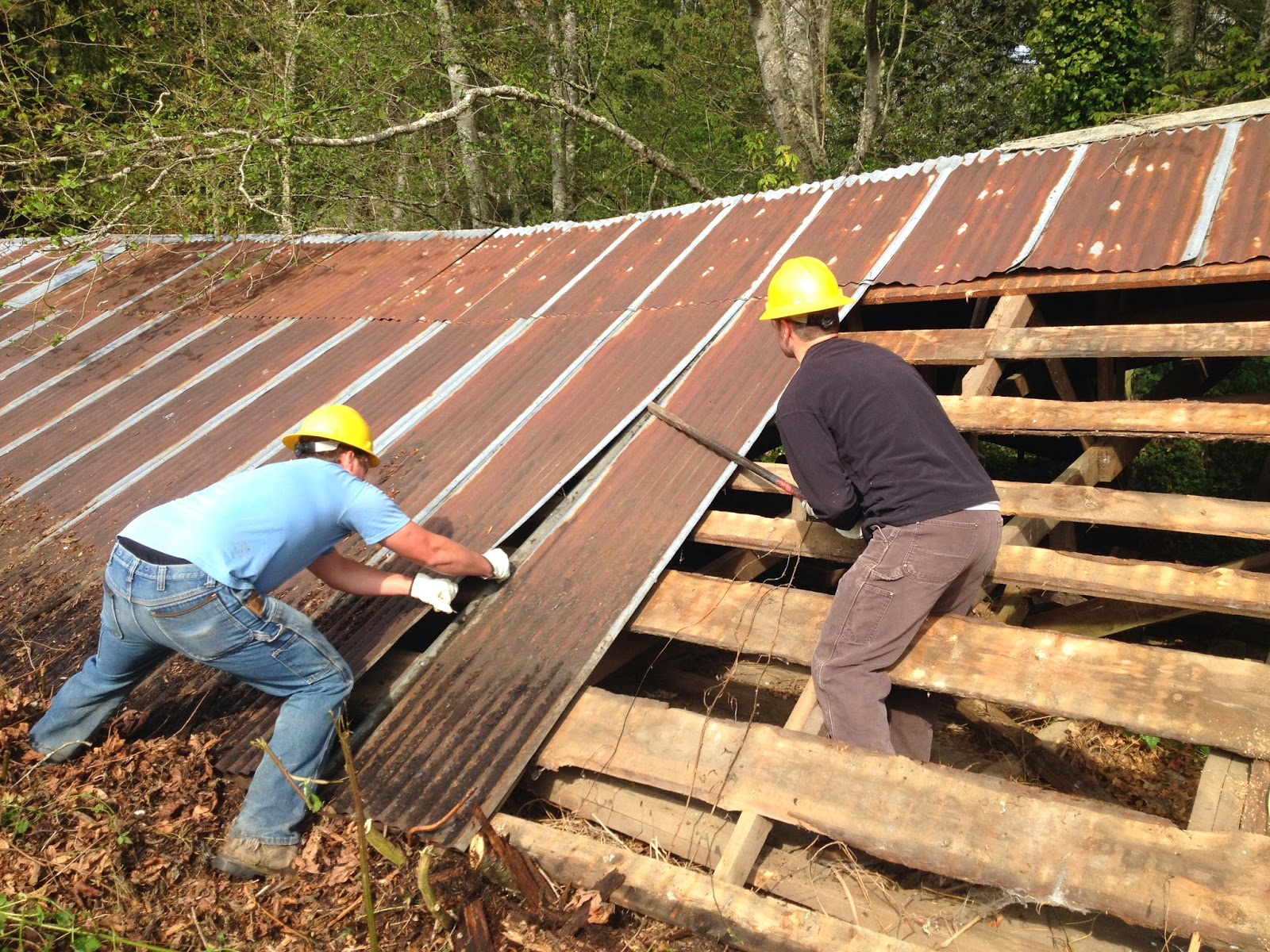
The crew's job was to salvage sheet metal roofing from an old mill building as well as remove scotch broom and Ivy from several different key locations.


These roof panels will later be repurposed for interpretive sign kiosks.
The crew pulled and piled a very large amount of ivy and scotch broom as well.  The crew hand pulled these plantrs in areas that the machines will not be accessing during the construction phase of the railroad grade removal.

Here is Kori standing next one of the crew's piles of ivy that we pulled behind the mill building.

No that is not a stick.  That is one of the mature ivy vines thast Robbie pulled.

We found some vandalism at a nearby older site while we were in the area.  Someone had pulled several mature willow trees out.  Fortunately, willow are quite hardy.  We replanted them and pulled all the scotch broom in this area as well.

Above you see rick standing in a field of scotch broom.
Here you can see there is significantly less scotch broom.  We enjoyed the list of odd jobs we got on this 2 day stint.  We'll check in again soon.
Oh, we also may have a new record for ivy diameter.  We're talkin old growth here.

Thursday, March 27, 2014

Glendale Farm Replant

Glendale Farm is in Chimacum Washington.  They aren't farming much these days but a neighbor runs some cattle on the pastures. Chimacum Creek runs though the middle of the pastures.
There have been a couple attempts to plant this long stretch of creek in the past.  This stretch of Chimacum Creek is in CREP (conservation reserve enhancement program) managed by the Jefferson County Conservation District. Not only that, the landowner recently signed a conservation easement with the Jefferson Land Trust. The land owner now receives some financial compensation for both being in CREP and for the conservation easment.

That's when we come in.  Our role in this dance is the muscle.  We bring the trees and equipment and bodies in and get the plants in the ground.  We brought 7,400 plants to this sight and got busy.

First we prep. We clear 3 foot diameter scalps down to dirt.  In order to plant effectively we need to get bare ground.  Sometimes we do this with hoes this time we used our brushcutters.  rough on the equipment but faster. The scalping also helps stunt the growth of competing reed canary grass that dominates the site.


Then we plant and plant and plant.  It is a great deal of work. If you have ever volunteered at a tree planting, picture that  for 10 hours a day all week long...and then again next week somewhere else.


We will then return and put tree protectors around each tree and support them with bamboo stakes.  After this, provided our partners have the funding, we will return to maintain the site.  This part of the project is crucial for success. We will beat back the competing reed canary grass with brush cutters, and DR mowers then spray a 3 foot diameter circle of glyphosate around the tree protector.  This glyphosate kills the grass in the immediate area, allowing for a competition free root zone during the growing season.   This can be the difference between a new riparian forest and a failed attempt at a replant.  We grow forests. In a way, we are like farmers you gotta have some farmhands mind the crops or weeds take over.  After 3-5 years of treatment the site should be on its own (native plants should be emerged fully above canary grass permanently.) Another riparian forest brought to you by the WCC.

Tuesday, February 18, 2014

Snow Creek East Uncas

 Snow Creek Planting and Alder Thinning


 Today we are working on a recently acquired Jefferson Land Trust property located on Snow Creek  near East Uncas Road. The parcel includes both sides of the Snow Creek and abuts to Highway 101.  The project involved the crew coming out in January and thinning the Alder stand that occupies most of the outer eastern side of the site near highway 101.  This area was mostly Alders blackberry and reed canary grass.
Robbie opening up the alder stand to make room and open the canopy to plant shrubs and conifers.  At some sites there may already be trees but we are looking to diversify the shrubs and kick start coniferous forest. 
Muddy planters at lunch break.
Our plants generally come bare root in big paper bags from the nursery.  This is what we prefer, as opposed to potted stock that is cumbersome to move around and could be laden with weeds.  Here you see Elijah and Rick loading some western red cedar from the tree bags to their planting bags  When we use planting bags one person can carry 100 trees easily throughout the site. 
 
Kori planting a western red cedar.
When we have completed the planting we will put tree protector tubes over the plants in the grassy and blackberry infested areas.  These will protect the trees from voles, mice, deer, and our brush cutters.


Leland Creek Willow Staking

Leland Creek Willows
A view of our flooded job site @ Leland Creek
 

The crew has been working on a big project for Jefferson County Public Health.  We are installing over 13,000 willow stakes along Leland Creek.  The willow stakes are being installed along sections of the creek that are dominated by reed canary grass.  The intention is that the willows will flourish and begin to shade out the canary grass and provide shade over the creek as well.  The creek is ominously known for vast stretches of canary grass and beaver dams.  This scenario has caused the creek to back up and flood above the top of the creek banks for a significant portion  of the year.
Corp members Elijah Roulst and Kori Riggle laying out fence line
 
When the willows are installed a 4 foot high fence is then constructed around each to prevent beaver from gnawing the stakes down.  Generally the willow enclosures are 60 feet long and extend 30 feet back from the creek.
Building fences in this bog-like area is challenging.  But it is not a challenge beyond this crews abilities.  Above you can see Kori Riggle leveling an area to make the fence line level.  This will ensure that the the bottom of the fence is tight excluding the beaver from the willows while the stakes are growing into trees.

A rare sunny day at the job site.  The crew has had all working conditions at this job site.  Snow, freezing weather, sun, and currently rain, rain, rain.  Most of the site is submerged under water.  There will be some rooted plant stock installed in some of the areas that are not saturated.  We return to that Job next week and hope to get the willow planting wrapped up.
   

Wednesday, December 11, 2013

The 2013- 2014 Port Hadlock WCC Crew

 
Here are the corps members of the 2013-2014 Port Hadlock WCC Crew in their native habitat. The photo was taken at upper reach of Chimacum Creek where the crew was doing some trail work and planting preparation.
The crew has been working together since October. This is the 5th Port Hadlock WCC crew sponsored by the North Olympic Salmon Coalition. We have 3 folks that have served with the WCC in the past and 2 folks just beginning their WCC experience. It has been great having an experienced crew especially because I missed a good portion of the beginning of the service year when our newest daughter Cedar was born.We are now just over two months into the year and we are a bit overdue, so it is time to introduce the crew:

Rick Humphrey

Hi, my name is Rick Humphrey.  I am currently working a 2nd year with the Washington Conservation Corps.  I plan to go to school to learn how to build, maintain, and deconstruct high voltage power lines.  This year with the WCC, I hope to gain new skills in the field such as wild land firefighting and rigging.  Some of my pastime hobbies include; fishing, hunting, camping, watching movies, playing in the snow, hiking, and playing video games.  Hopefully you somewhat enjoyed reading my brief explanation of myself!
 

Elijah Roulst

 
 Hell, my name is Elijah Roulst.  Born and raised in the Pacific North West, Port Townsend to be exact.  While not at work taking care of business, you can usually find me in the beat lab making music.  I enjoy walks on the beach, sunsets, rain, surfing, hiking, hunting, fishing, spending time with family or friends, or going to a show/festival.  I currently work for two different record labels, and am working on multiple projects, some being photography the other being being music.  GO HAWKS!  over-n-out
 

Dylan Kelly

My name is Dylan Kelly, I was born and raised in Port Townsend. I plan on going on using my Americorps education award to go to community college after the year is done.  ON my free time I like to go mountain biking when I can and spend time with friends and family.

Kori Riggle

I have no real skills that could be useful in anyway, but I do have 5 cats, 2 dogs, and 5 annoying birds.  I love Anime and Asian culture.  At some point in my life I plan to travel all of Asia.  I enjoy cosplay and going to conventions.  I plan on moving to Seattle next  year.
 

Robbie Holt

 
 Hi, My name is Robbie Holt, this is my first year with the WCC.  I am originally from Seattle and the only person not originally from the Chimacum area.  When not at work I like to row, bike, and climb.  This year I am looking forward to doing more stinky fish jobs and getting some good environmental work experience.  Bring on the stinky fish jobs!

Owen French

I'm Owen French, supervisor of the crew.  This is the 8th WCC crew that I have supervised.  When not at work, I can be found spending time with my wife and two daughters, or I could be out hunting, fishing, or enjoying music.