Tuesday, February 18, 2014

Snow Creek East Uncas

 Snow Creek Planting and Alder Thinning


 Today we are working on a recently acquired Jefferson Land Trust property located on Snow Creek  near East Uncas Road. The parcel includes both sides of the Snow Creek and abuts to Highway 101.  The project involved the crew coming out in January and thinning the Alder stand that occupies most of the outer eastern side of the site near highway 101.  This area was mostly Alders blackberry and reed canary grass.
Robbie opening up the alder stand to make room and open the canopy to plant shrubs and conifers.  At some sites there may already be trees but we are looking to diversify the shrubs and kick start coniferous forest. 
Muddy planters at lunch break.
Our plants generally come bare root in big paper bags from the nursery.  This is what we prefer, as opposed to potted stock that is cumbersome to move around and could be laden with weeds.  Here you see Elijah and Rick loading some western red cedar from the tree bags to their planting bags  When we use planting bags one person can carry 100 trees easily throughout the site. 
 
Kori planting a western red cedar.
When we have completed the planting we will put tree protector tubes over the plants in the grassy and blackberry infested areas.  These will protect the trees from voles, mice, deer, and our brush cutters.


Leland Creek Willow Staking

Leland Creek Willows
A view of our flooded job site @ Leland Creek
 

The crew has been working on a big project for Jefferson County Public Health.  We are installing over 13,000 willow stakes along Leland Creek.  The willow stakes are being installed along sections of the creek that are dominated by reed canary grass.  The intention is that the willows will flourish and begin to shade out the canary grass and provide shade over the creek as well.  The creek is ominously known for vast stretches of canary grass and beaver dams.  This scenario has caused the creek to back up and flood above the top of the creek banks for a significant portion  of the year.
Corp members Elijah Roulst and Kori Riggle laying out fence line
 
When the willows are installed a 4 foot high fence is then constructed around each to prevent beaver from gnawing the stakes down.  Generally the willow enclosures are 60 feet long and extend 30 feet back from the creek.
Building fences in this bog-like area is challenging.  But it is not a challenge beyond this crews abilities.  Above you can see Kori Riggle leveling an area to make the fence line level.  This will ensure that the the bottom of the fence is tight excluding the beaver from the willows while the stakes are growing into trees.

A rare sunny day at the job site.  The crew has had all working conditions at this job site.  Snow, freezing weather, sun, and currently rain, rain, rain.  Most of the site is submerged under water.  There will be some rooted plant stock installed in some of the areas that are not saturated.  We return to that Job next week and hope to get the willow planting wrapped up.
   

Wednesday, December 11, 2013

The 2013- 2014 Port Hadlock WCC Crew

 
Here are the corps members of the 2013-2014 Port Hadlock WCC Crew in their native habitat. The photo was taken at upper reach of Chimacum Creek where the crew was doing some trail work and planting preparation.
The crew has been working together since October. This is the 5th Port Hadlock WCC crew sponsored by the North Olympic Salmon Coalition. We have 3 folks that have served with the WCC in the past and 2 folks just beginning their WCC experience. It has been great having an experienced crew especially because I missed a good portion of the beginning of the service year when our newest daughter Cedar was born.We are now just over two months into the year and we are a bit overdue, so it is time to introduce the crew:

Rick Humphrey

Hi, my name is Rick Humphrey.  I am currently working a 2nd year with the Washington Conservation Corps.  I plan to go to school to learn how to build, maintain, and deconstruct high voltage power lines.  This year with the WCC, I hope to gain new skills in the field such as wild land firefighting and rigging.  Some of my pastime hobbies include; fishing, hunting, camping, watching movies, playing in the snow, hiking, and playing video games.  Hopefully you somewhat enjoyed reading my brief explanation of myself!
 

Elijah Roulst

 
 Hell, my name is Elijah Roulst.  Born and raised in the Pacific North West, Port Townsend to be exact.  While not at work taking care of business, you can usually find me in the beat lab making music.  I enjoy walks on the beach, sunsets, rain, surfing, hiking, hunting, fishing, spending time with family or friends, or going to a show/festival.  I currently work for two different record labels, and am working on multiple projects, some being photography the other being being music.  GO HAWKS!  over-n-out
 

Dylan Kelly

My name is Dylan Kelly, I was born and raised in Port Townsend. I plan on going on using my Americorps education award to go to community college after the year is done.  ON my free time I like to go mountain biking when I can and spend time with friends and family.

Kori Riggle

I have no real skills that could be useful in anyway, but I do have 5 cats, 2 dogs, and 5 annoying birds.  I love Anime and Asian culture.  At some point in my life I plan to travel all of Asia.  I enjoy cosplay and going to conventions.  I plan on moving to Seattle next  year.
 

Robbie Holt

 
 Hi, My name is Robbie Holt, this is my first year with the WCC.  I am originally from Seattle and the only person not originally from the Chimacum area.  When not at work I like to row, bike, and climb.  This year I am looking forward to doing more stinky fish jobs and getting some good environmental work experience.  Bring on the stinky fish jobs!

Owen French

I'm Owen French, supervisor of the crew.  This is the 8th WCC crew that I have supervised.  When not at work, I can be found spending time with my wife and two daughters, or I could be out hunting, fishing, or enjoying music. 

Thursday, May 23, 2013

Smolt Trapping with Cheri

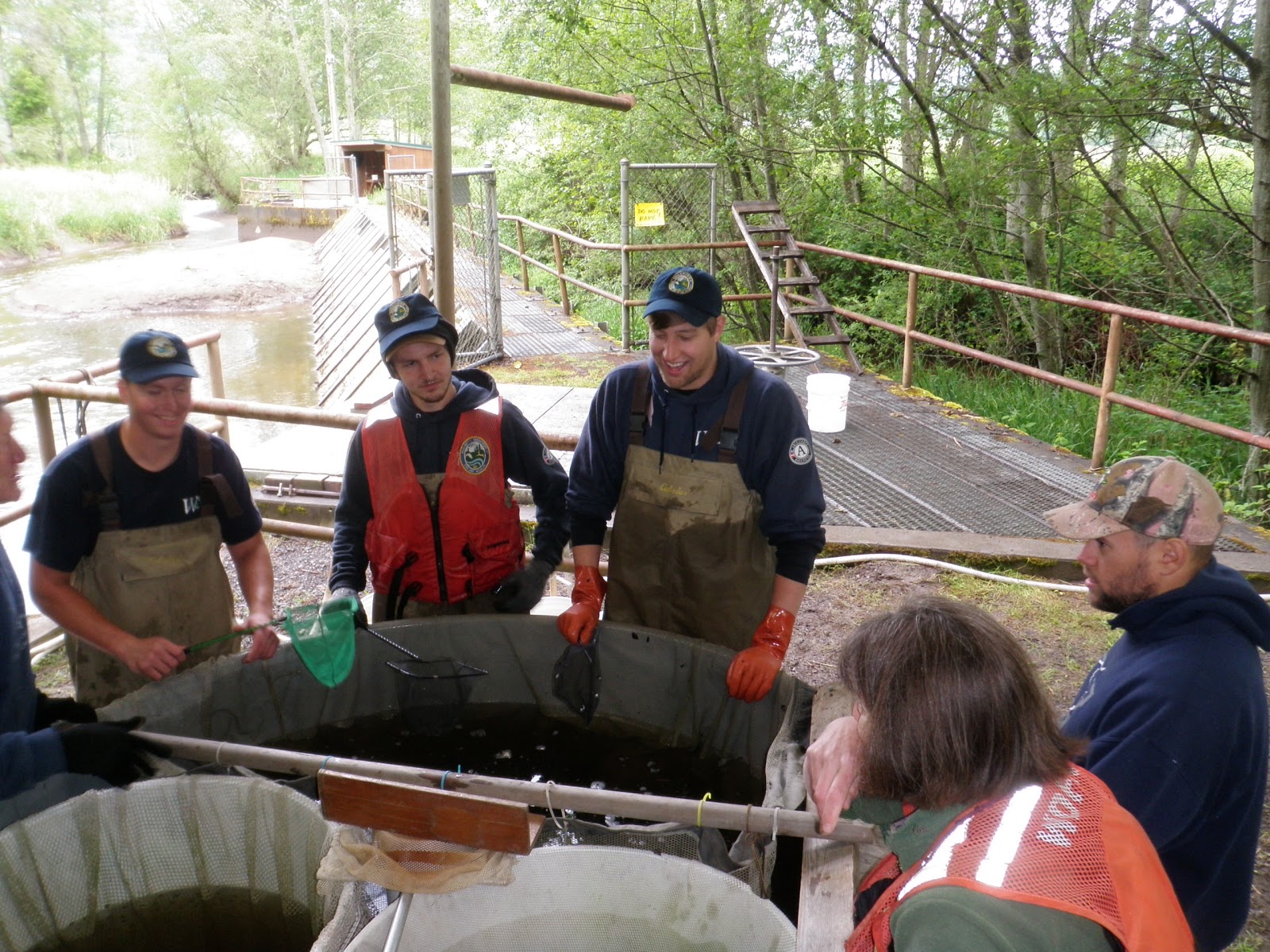
Earlier this week we met Cheri at the WDFW fish weir on Snow Creek for a morning of delicious cupcakes and some smelt trapping. The crew was stoked to get in the water and play with some fish. Zach and Rick got in the water with the net to scare the fish into the holding tank. Once in the tank two people went in to pull out the smolt. We loaded them up in the pool to begin counting them. Zach, Colin and Rick were identifying the fish while I pushed the counter buttons. We seined twice and came away with about 1500 fish, which put the annual number over 30,000 out migrating coho! an impressive run!


Fyke Netting

A couple of months ago we were able to go out with Jac and Anna (the IP) and do some fyke netting at discovery bay. We were looking for forage fish and out migrating smolt numbers. The crew split in two and covered two little channels. It's always a good day when you can put the wadders on and play in the water. The group I was with only caught 2 sculpin in our net and we surveyed about 7 other sculpin. The other group had many more fish than we did. On the car ride over we learned our plant of the week, which was indian plum. I'm busy looking at the flowers of indian plum so that I can show the rest of the crew the difference between the male and female flowers.

Rhody Parade

Here in Port Townsend it is that time of year, spring is here, the weather can't decide if it's going to rain or not, and the Rhody festivities are in full swing. We decorated the truck and lined up for the parade!
With Finn in tow we were ready for the parade

Creosote Log Removal


Earlier in the year Rick crew swapped to do some creosote log removal off of the Dungeness Spit. He had quite the experience that made the rest of the crew slightly nervous about what to expect with this week. Monday morning we loaded up the truck and drove to Silverdale and met Kevin from DNR Aquatics. He gave us a rundown, the usual safety, history and SOP procedures and we went to work. The job was a lot of lifting. We had these cool tools called log tongs (eventually referred to as long-duck-dongs) that would pinch the logs and give us an efficient way to move the logs. We would grab logs that weren't too heavy with the log tongs and carry them to a large dumpster. We also picked up little bits of debris and some trash. At our first site there was a derelict vessel that we had to pull up the bank. If a log was to large to carry with the 6 of us we would cut it in pieces, but, if we did any cutting we would have to be certain to catch all the chips that fly off the chainsaw. So cutting was simultaneously helpful and frustrating. Creosote also increases photosensitivity in the skin and causes sun burns. A few of us on the crew got some pretty bad burns. By the end of the first day we managed to fill one of the large dumpsters and make it home safely and exhausted.
On Tuesday we wrapped up at the first site in Silverdale and surveyed our site for Wednesday and Thursday. Once we finished that we did creosote log surveys and trash removal at Shine Tidelands State Park. We walked along the beach and would take GPS coordinates and measurements of any creosote logs that we found for future reference. It was a beautiful day for a walk on the beach!
For Wednesday and Thursday we went to Point No Point, unanimously the crew's favorite site of the year. From the lighthouse here there are views from Mt. Baker all the way south to Mt. Rainier. It was very cool to be working here. Once the work began it was definitely helpful to be able to look up at the sights and get a bit of a boost. Anyway, Wednesday and Thursday were more of the same. Picking up, dragging, cutting creosote logs. We would take lunch and head to the Hansville store and get some ice cream or something cold and then head back to work.
After 4 days of work we filled up about 3 large dumpsters worth of creosote. We are all looking forward to the next time we get to work with Kevin after he told us there will be a helicopter involved.
Kevin gave us a pamphlet that described the importance of creosote log removal. It said that they have removed about 7500 tons of creosote over the last few years. That is an amazingly large number of creosote to have removed.
we did this all day every day for 4 days

we work up a big appetite doing this kind of work

GPSing creosote

Moving more logs
Point No Point, the coolest work site ever!